When the Lights Went Out and the Dog Ran On: Football Telly's Greatest Glorious Cock-Ups
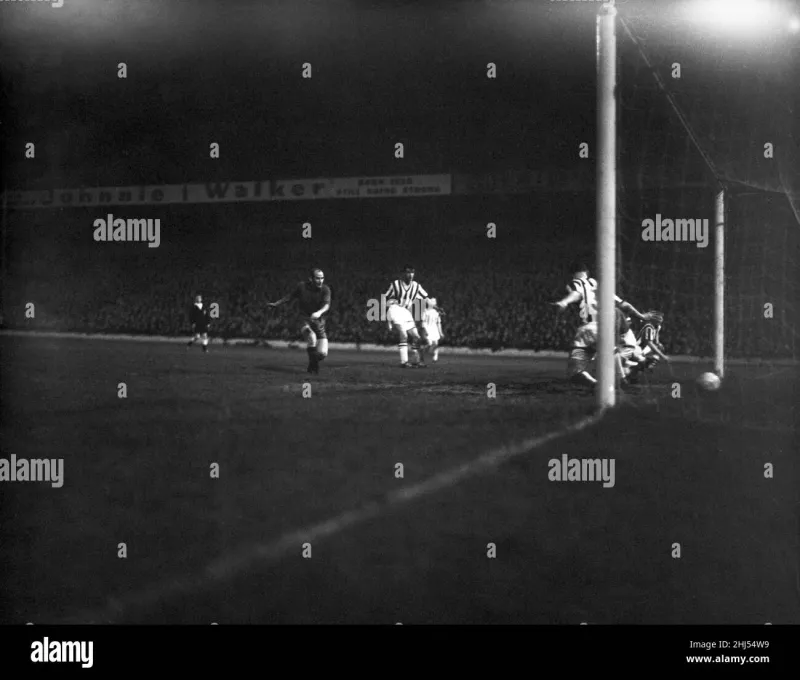
Photo: vintage football floodlights rainy night match old television broadcast, via c8.alamy.com
There's a particular kind of magic to old football footage that you simply can't manufacture. Not the slow-mo replays, not the drone shots, not the augmented reality graphics sliding across your screen. No — we're talking about the proper chaos. The broadcast disasters. The moments where British football telly fell over, picked itself up, and accidentally created folklore in the process.
The Night the Floodlights Weren't the Problem
Start with the basics: for decades, the single greatest obstacle to showing football on the box wasn't rights disputes or scheduling clashes. It was the National Grid. Television in Britain grew up alongside a creaking power infrastructure, and every so often the two would collide spectacularly.
The 1970s were the golden age of the broadcast meltdown. Industrial action meant that a cup tie could vanish from screens mid-half because the technicians' union had called a walkout. Viewers would be watching a tense derby one minute and a test card, or worse, an apologetic continuity announcer, the next. And here's the distinctly British bit: nobody really complained. There was a strange national shrug about it all. The match would be described in hushed tones the next day by those who'd been there, and the rest of the country simply had to take their word for it. Football as oral tradition, kept alive by a strike roster.
A Hound, a Pitch and a National Treasure
Then there's the animal kingdom. Every football nation has pitch invasions, but only Britain seems to produce pitch invasions by dogs with impeccable comic timing. The most famous, of course, is the story of Bundle — the stray who gatecrashed a match in the 1960s and, in the process, became arguably the only animal ever to win a medal for it. The cameras caught the whole thing: a scruffy mutt weaving between professional athletes, evading tackles with a cheek that some forwards could study, before being caught, adopted and handed a winner's medal by the club chairman.
What makes it gold isn't just the footage — it's the commentary. The commentator didn't panic. He didn't go quiet. He narrated the dog like it was the most natural thing in the world, because in Britain, it genuinely half was. That tone — dry, unbothered, faintly amused — is the through-line of every great British broadcast mishap.
Weathering the Storm, Literally
Talk to anyone who's ever lugged a camera up a rickety scaffold at a windswept ground in January and they'll tell you the same thing: the weather is the unseen star of British football telly. There are matches from the 1980s where the outside broadcast unit spent more energy keeping the camera upright than keeping it in focus. Rain hammering the lens. Umbrellas appearing frame-left. One legendary gallery director reportedly kept broadcasting through a hailstorm on the grounds that 'the viewers can hear it, it's atmospheric.'
And honestly? He had a point. There's something deeply comforting about watching footage where you can hear the rain on the microphone, the crowd's breath visible in the floodlights, the commentator's hot Bovril steaming on the desk. Modern broadcasts are crystal-clear and utterly interchangeable. The old ones had weather. They had geography. You knew you were watching Hartlepool in February, and the telly told you so whether you liked it or not.
The People Behind the Panic
We spoke — informally, over many cups of tea — with people who worked in outside broadcast units during this era, and a theme kept recurring: nobody ever really knew what was going to happen, and that was the job. Cameras failed. Links dropped. One veteran remembered a match where the only working camera angle for twenty minutes was one trained, by complete accident, on the away end — and the director, rather than cut away, made it a feature. 'Best twenty minutes of crowd reaction we ever aired,' she said. 'You could see arguments starting. You could see blokes hugging strangers. It was better than the football.'
That's the secret, really. The glitches worked because the people behind them treated chaos not as a failure but as part of the show. There was no fallback, no redundancy, no five-second delay. Just a gallery of people making it up as they went along, live, to millions.
Why We Miss the Mess
You could argue, fairly, that we've traded all this for something better. Broadcasts today are seamless, polished, global. But seamless can also mean soulless. When was the last time a technical fault made you laugh out loud? When did a broadcast accident become a story you told your mates about?
The great British broadcast cock-ups endure because they were honest. They showed the game as it actually was — played in terrible weather, watched by soaked crowds, occasionally interrupted by dogs and darkness and the National Grid having a think. They were imperfect, and that's precisely why we remember them. In an age where every pixel is managed, there's something worth celebrating about the night the lights went out and the telly simply shrugged and carried on.
Here's to the glitches. May we never fully smooth them out.