The Club That Learned to Pose: Why Anfield Was Made for the Camera Long Before Instagram
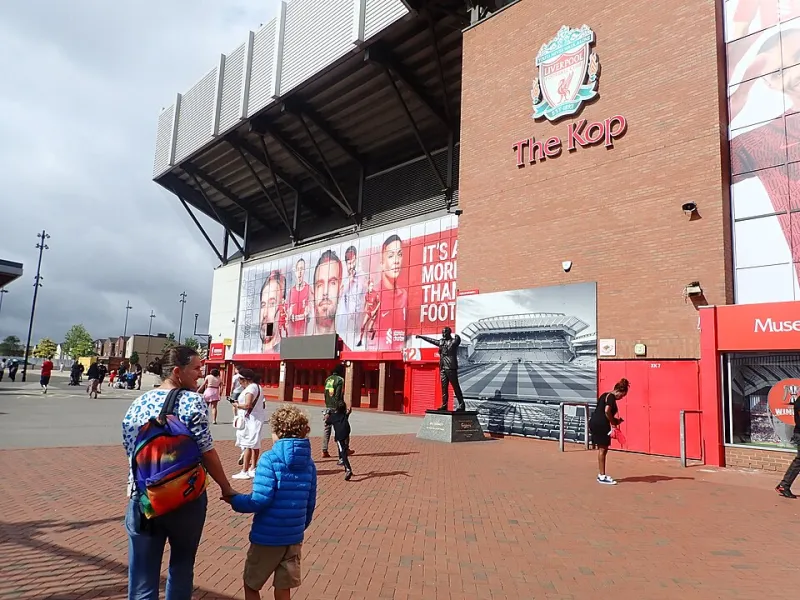
Photo: Eirian Evans , CC BY-SA 2.0, via Wikimedia Commons
There's a moment every TV director knows. You've got a helicopter up, a steadicam in the tunnel, fourteen cameras dotted around the ground — and still, the shot that'll open the montage is the same one it's been since the sixties: the Kop, rising as one, a wall of red and noise that needs no caption, no context, no explaining.
Liverpool didn't just get good at football under Bill Shankly. They got good at looking like Liverpool. And that, more than anything, is why the club became the most televised institution in British sport.
Shankly Understood the Soundbite Before Soundbites Existed
Television in the early 1960s was hungry. The BBC and ITV were expanding their sports coverage, and they needed personalities — men who'd say something worth repeating in the pub the next night. Shankly was a gift.
"Some people believe football is a matter of life and death. I'm very disappointed with that attitude. It's much more serious than that."
He said things like that with a straight face and a fag on, and every clip survives because it was built to survive. Other managers of the era gave monotone interviews about the lads putting in a shift. Shankly gave the cameras theatre. He wasn't performing, exactly — he meant it all — but he understood that a football club's story travels on the words attached to it.
The result: Liverpool became the first British club with a quote archive. Documentary makers have been mining it ever since, and every new generation of producers rediscovers the same gold.
The Kop Was the Original Drone Shot
Before aerial cameras, before crane rigs, the Kop did the job of the spectacular visual all by itself. A single-tier stand holding tens of thousands, all facing the pitch, all singing — it photographed like nothing else in the country.
Directors noticed. Match of the Day producers noticed. When they wanted a shot that said this is what English football means, they pointed a lens at Anfield. The stand became shorthand — for passion, for scale, for the whole romantic idea of the game. You didn't need to know the score to understand the picture.
Modern broadcast packages still lean on it. The sweeping stadium flyovers, the pre-match light shows, the slow-motion crowd montages — they're all variations on a visual idea Liverpool effectively patented: the crowd as the star.
'This Is Anfield' — Four Words That Film Themselves
Every visiting player walks past the sign above the tunnel. Every camera crew films them doing it. It's a ritual so perfectly televisual that it feels designed for the medium — a doorway, a symbol, a psychological claim, all in one frame.
The sign was put up in the Shankly era to intimidate opponents, but it's become something else entirely: a broadcast landmark. Documentaries linger on it. Pundits reference it. Aerial shots frame the stadium around it. There are Premier League grounds with bigger capacities and shinier facilities, but none of them have a single image as instantly recognisable.
That's the trick Liverpool pulled off. They didn't just win things — they built iconography. And iconography is what television feeds on.
The Documentary Era Just Finished the Job
When streaming platforms came looking for football stories, Liverpool were the obvious subject. The access, the history, the characters, the visuals — it was all sitting there, ready-made. Productions about the club don't have to manufacture drama; they just have to point cameras at what's already there.
And the borrowing goes both ways. Modern fan channels, montage editors and highlight packages — the whole ecosystem of football media that's grown up online — constantly recycle the same Anfield imagery: the tunnel, the sign, the Kop in full voice, the grainy Shankly clips. It's a shared visual language now, and Liverpool wrote most of the vocabulary.
Other clubs have moments. Liverpool has a catalogue.
Why It Still Matters
There's a lesson in here for anyone wondering why some clubs dominate the media conversation while others don't, despite similar success on the pitch. It's not just trophies. It's whether your club gives storytellers something to work with — faces, phrases, images, rituals.
Liverpool figured that out decades before anyone else, mostly by accident and partly because Shankly was a natural showman running a club that let him be one. Sixty years on, every broadcast director, every YouTube editor and every documentary producer is still working with the material he left behind.
The lights, the cameras, the flyovers — they came later. Anfield was ready for them all along.